




Printz v. United States
United States Supreme Court
521 U.S. 898 (1997)
- Written by Megan Petersen, JD
Facts
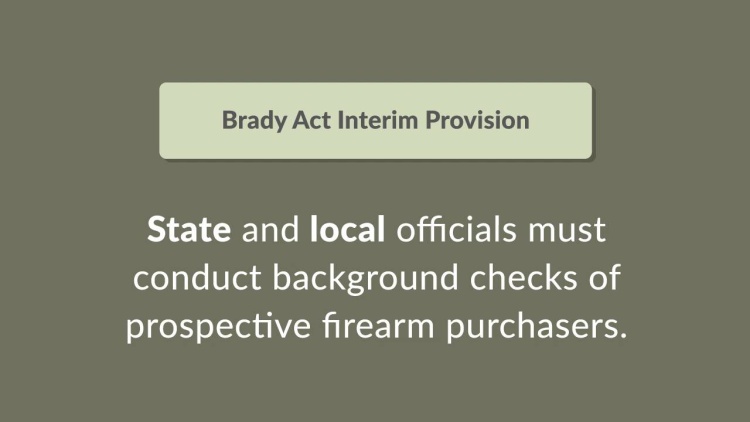
Congress enacted the Brady Handgun Violence Prevention Act (Brady Act) in 1993 as an amendment to the Gun Control Act of 1968. The Brady Act was a federal gun-control provision that required the United States attorney general to implement a nationwide handgun background-check system. In the interim, while a national system was being developed, the Brady Act required state and local officials to conduct background checks on prospective firearm purchasers. Under the Brady Act, sellers of firearms would report sales to their county chief law-enforcement officers (CLEOs). The CLEOs would then conduct background checks and confirm the lawfulness of the sales. Printz and Mack (plaintiffs) were CLEOs in Montana and Arizona, respectively. They separately brought suit in federal district court against the United States government, alleging that the Brady Act was an unconstitutional exercise of congressional power because it compelled state officers to participate in federal service. The district courts held that the provision of the Brady Act mandating that CLEOs perform background checks was unconstitutional. However, they held that the background-check provision could be severed from the rest of the act, leaving a voluntary, nonmandatory local background-check system constitutionally in place. The Ninth Circuit consolidated the cases and reversed in part, holding that the entirety of the Brady Act was constitutional, including the provision requiring CLEOs to perform background checks. The Supreme Court granted certiorari.
Rule of Law
Issue
Holding and Reasoning (Scalia, J.)
Concurrence (Thomas, J.)
What to do next…
Here's why 903,000 law students have relied on our case briefs:
- Written by law professors and practitioners, not other law students. 47,100 briefs, keyed to 995 casebooks. Top-notch customer support.
- The right amount of information, includes the facts, issues, rule of law, holding and reasoning, and any concurrences and dissents.
- Access in your classes, works on your mobile and tablet. Massive library of related video lessons and high quality multiple-choice questions.
- Easy to use, uniform format for every case brief. Written in plain English, not in legalese. Our briefs summarize and simplify; they don’t just repeat the court’s language.